Side project · Live
Weather Forecast for Linear
A team-load weather report for Linear. See who is overloaded now and who is about to be, and hand work over before the storm.
- When
- 2026
- Stack
Each person’s open issues in Linear land in an Eisenhower matrix (Do, Schedule, Delegate, Drop). Their urgent load is compared with the team average, scaled to how much of a week they work and leaving out anyone on time off. That becomes weather: ☀️ ⛅ 🌧️ ⛈️ for today, and a forecast for the next few weeks based on when each issue turns urgent. A PM can see who’s in a storm or about to be, and Rebalance suggests who should take what and makes the moves in Linear.
The demo workspace: Tony is in a storm now, and others over the next weeks. Rebalance hands today’s urgent work over in one go, then the work ahead of each storm, and the forecast clears.
Why I built it
I wanted to learn GraphQL properly, from both ends. The app reads Linear’s GraphQL API and serves its own schema on top
of it, extending Linear’s Issue, User and Team with fields like quadrant, weather and forecast(weeks:). That
gave me a reason to use most of what GraphQL offers: DataLoader batching, mutations that return their expected failures
as union types, trusted documents and query limits, and subscriptions fed by Linear’s webhooks.
How it’s put together
The rules for what counts as important or urgent are data, not code. Each team has a row in D1, and the engine is plain functions of rules, issues and a date. That’s also what makes the forecast cheap: next week is the same function with a different date.
I could have built a small REST service beside Linear that returns each person’s weather. Instead the derived fields live on Linear’s own types, so the board gets an issue’s title and its quadrant in one query, and if nobody asks for a forecast, none is computed. The price is a batching layer and query limits, since a schema with cycles can be asked for a lot.
Linear’s rate limits shaped the queries I send it. They’re hand-written .graphql files that codegen checks against
Linear’s schema. They ask only for the fields the matrix needs, in pages small enough to stay under Linear’s complexity
budget.
Changes made in Linear show up on the board straight away: Linear’s webhooks reach a Durable Object per team, which pushes the update to every open board over server-sent events.
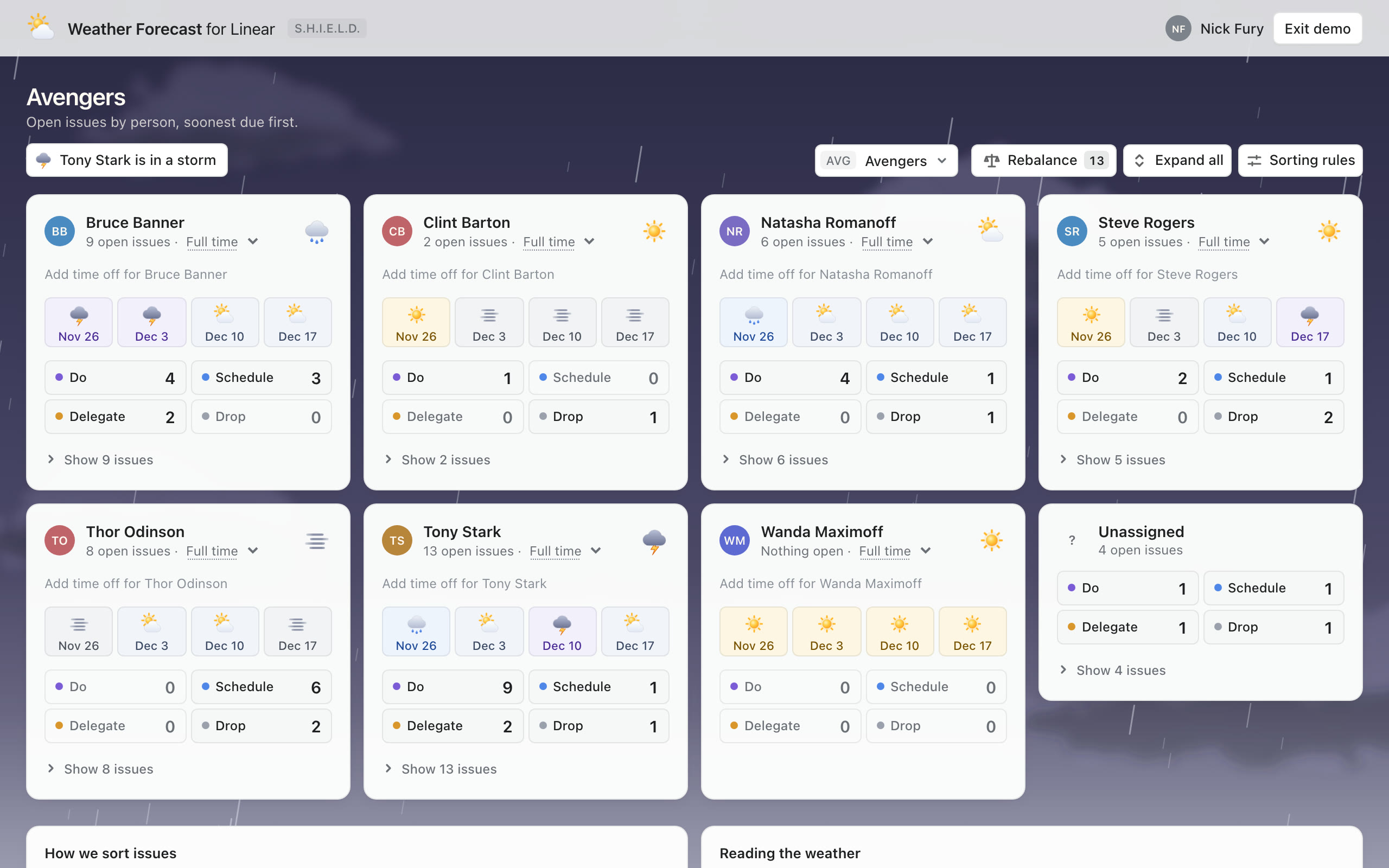
The board, with each person’s weather, forecast and quadrant counts.