Give the AI something to lean on
Product engineering used to come with an entry exam. Before you got to the fun part, deciding what the thing should do and how it should feel, you had to know the framework, the build tool, the browser quirks and the exact incantation for this version of that library.
The exam is mostly gone. An agent will scaffold the app, write the migration and fix the flaky test while you make coffee. What’s left, and suddenly worth a lot more, is taste: which flow feels right, which feature to cut, what the product is actually for.
Which makes Rick Rubin a surprisingly good role model for engineers. He’s produced records for Johnny Cash, the Beastie Boys, Slayer and the Red Hot Chili Peppers. Here he is on how much he knows about music:
Rick Rubin on what he actually brings to a record.
What he brings isn’t technique. It’s taste, and knowing what the record is meant to be. The people in the room can play. He’s the one who remembers why.
Coding agents are the session musicians of your dreams: they can play every instrument, sight-read anything and never need a second take. They’ll write the migration, the component and the tests faster than you can read them. They just don’t listen to the music, and they have no memory of what record you’re making. Every session starts from nothing, reads whatever code is in front of it and makes the change that looks right from there.
In the last post I wrote about how people talk to each other now that AI can write a wall of text in seconds. This one is the same idea from the other side: how you talk to the AI. A longer prompt rarely helps. What helps is giving it something solid to lean on, and the most useful thing to lean on is a written record of what the product is meant to do.
Drift is quiet
Nobody decides to turn a codebase into slop. It happens one reasonable change at a time.
An agent fixes a bug by patching the nearest file instead of the place the rule actually lives. Another adds a flag rather than reading why the code works the way it does. A third finds a limit, say “free accounts get three projects”, can’t tell whether it’s a product decision or an accident, and quietly changes it to make a test pass. Each change is fine in its own diff and passes review. A few months later the code still says what it does, but nobody, human or agent, can say what it’s meant to do.
That’s the drift: away from product intent, one session at a time. And it compounds, because the next agent learns what the product is from the code, including everything the last few got slightly wrong.
The fix isn’t a better prompt. The intent has to live somewhere outside the chat, where every session can read it and where you, not the agent, decide what it says.
Written intent, and why it rots
The obvious answer is to write it down. A CLAUDE.md, architecture docs, notes on where things live and why. On
Flex the docs are the one thing every change has to keep up to date: where things live, how they fit together and
why. On top of that we’ve experimented with wayfinder, to help the agent
find its way around, and OpenSpec for specs.
I liked OpenSpec a lot at first. You describe each part of the system as requirements with scenarios, and changes go in as deltas against those specs, so an agent reads what the product is meant to do before it touches the code. The trouble is that specs drift away from the code easily, and keeping them up to date turns into a chore that nobody wants. A spec that’s wrong is worse than no spec, because the agent trusts it.
So written intent on its own isn’t enough. You also need to know, cheaply and all the time, when the writing and the code stop agreeing, and to decide which one is right.
blueprint
That’s why I started building blueprint, a Claude Code plugin for larger changes. It’s built around one rule: the specs are the source of truth for intent, the code is the source of truth for behaviour, and when they disagree on something a user would notice, the agent asks you instead of picking one.
A heads-up: blueprint is moving fast, and this post describes an early version of it. It can already check coverage too, with tests tagged with the scenarios they cover, and I have a lot more ideas for it. The project page is where the current state lives.
It works in a loop:
- You bring the solution.
/blueprint <the change you have in mind>plays it back, sketches it and grills it in a few short rounds. It challenges your design only where it collides with a fact in the code. The decisions stay yours. - It writes the change down twice. A plain-text brief for agents, with the decisions, the spec delta and the tasks, and a visual review for people, with a before → after diagram. Both live where your team already keeps docs (Notion by default), not in the repo.
- It builds against the brief.
/blueprint applyworks task by task, checks each requirement against the code, and folds the delta into the capability specs when it’s done. - It notices drift. A small
.blueprint/folder in the repo maps each capability to the code that implements it. From git alone, a script can tell which capabilities’ code changed since their spec last agreed with it, so a pull request can say “these specs need another look” without anyone remembering to check.
Drift goes two ways, and blueprint treats them differently. If the code strayed from the spec,
/blueprint-drift judges the code against the spec and fixes the code. If the spec fell behind the code,
/blueprint-sync judges the spec against the code and fixes the spec. Either way, anything a user would notice
comes back to you as a question.
Here’s the free plan from earlier, with a drift check watching it:
Requirement: Free plan
A free account SHALL have at most 3 projects. Creating one more SHALL show the upgrade prompt.
export const FREE_PROJECT_LIMIT = 3;Spec and code agree.
An agent is asked to fix a failing onboarding test. The test creates four projects on a free account.
A toy version of the loop. The real thing, with the pane, the reviews and the capability map, is on the blueprint page.
This is the Rick Rubin split. The agent does the playing: it reads the code, finds the facts, writes the specs and the diffs. You keep the part only you can do: deciding what the thing is meant to be.
That doesn’t make technical knowledge optional. Rubin may not play, but he’s spent decades in studios and can tell when a take is wrong. It’s the same with agents: taste only works if you know the field well enough to spot when a spec is naive or a diff quietly breaks something. The knowledge moved from writing the code to judging it.
What it looks like in practice
jambo, a collaborative music board I’ve been building, runs blueprint. Its specs are public, and so is its history.
Here’s a real one. Over a few pull requests, the code that lets AI agents join a jam picked up some rules: a cap on how many agents fit in a jam, checks on the keys and names they send, and so on. Each was a sensible change. None of them made it into the spec. So the next agent to work on seating would have read a spec that knew nothing about the limits, and could have “fixed” them away.
A sync brought the spec back in line with the code. Part of what it added:
### Requirement: Agent seats

A jam SHALL seat at most 8 agents, and at most 3 from one client address; a new agent past
either limit SHALL be refused, telling it to pass its agent key. An agent already present
SHALL always get back in with its key.

- **Scenario: Fourth from one address**
  - **GIVEN** three agents from one address in a jam
  - **WHEN** a fourth call from that address comes without a key
  - **THEN** it is refused, and a call with one of the three keys still gets in
Now the limit is a decision written down, not an accident in the code. The next agent that touches seating reads it first.
The capability map shows the same thing for the whole repo: every capability, the ones that share files tied together, and drifted ones in red.
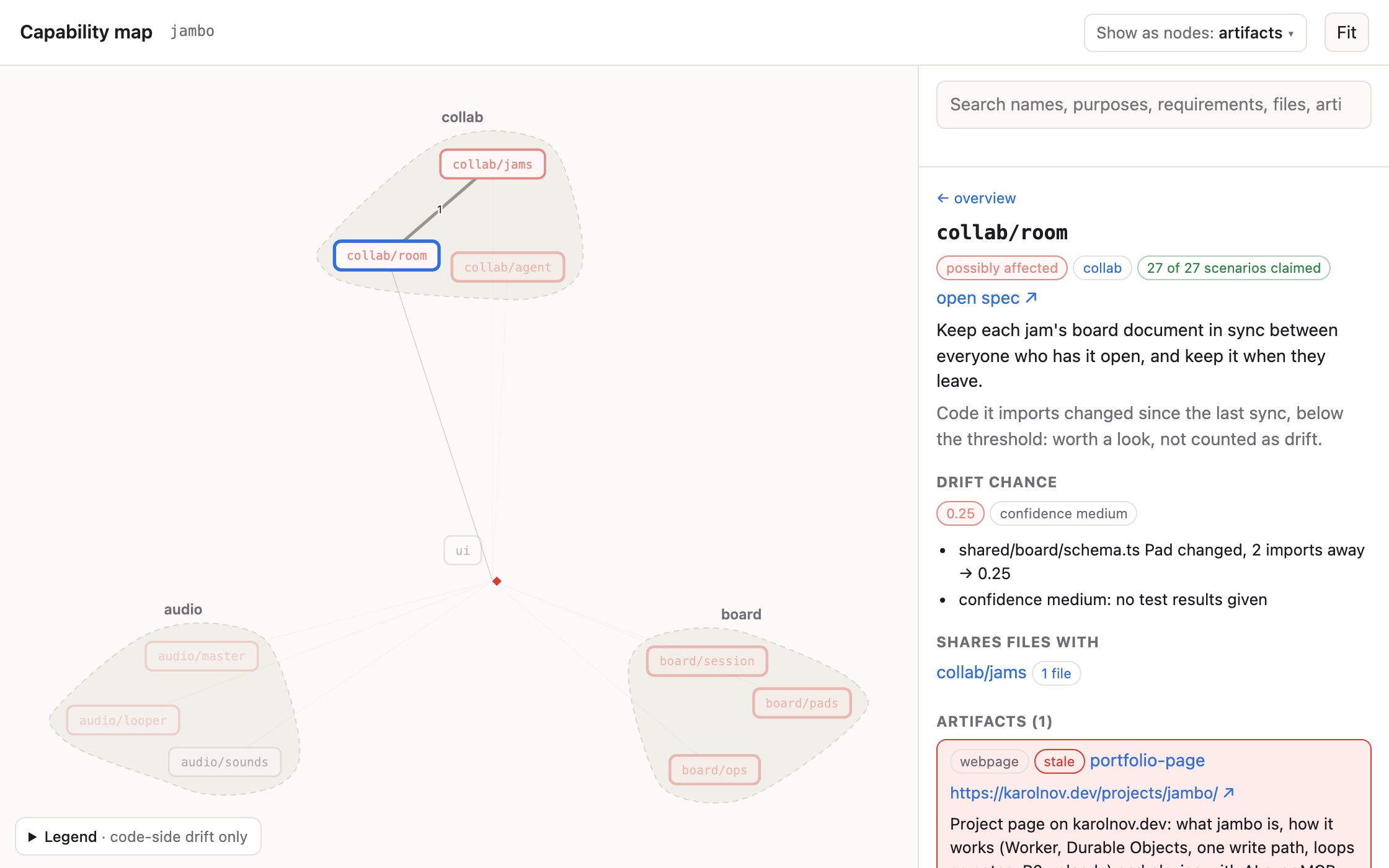
jambo’s capability map, with looper selected.
Without blueprint
You don’t need blueprint to get most of this. You need intent that’s written down, owned by you and checked against the code, often. Before you hand a change to an agent:
Further reading
- blueprint: the project page, with the pane, the PR plan and the capability map. The code is in my skills repo.
- OpenSpec: spec-driven development for coding agents. blueprint can import OpenSpec specs, and keeps them outside the repo instead.
- Matt Pocock’s skills, including wayfinder.
- Show, don’t prompt: the first post in this series, about the people side of the same idea.